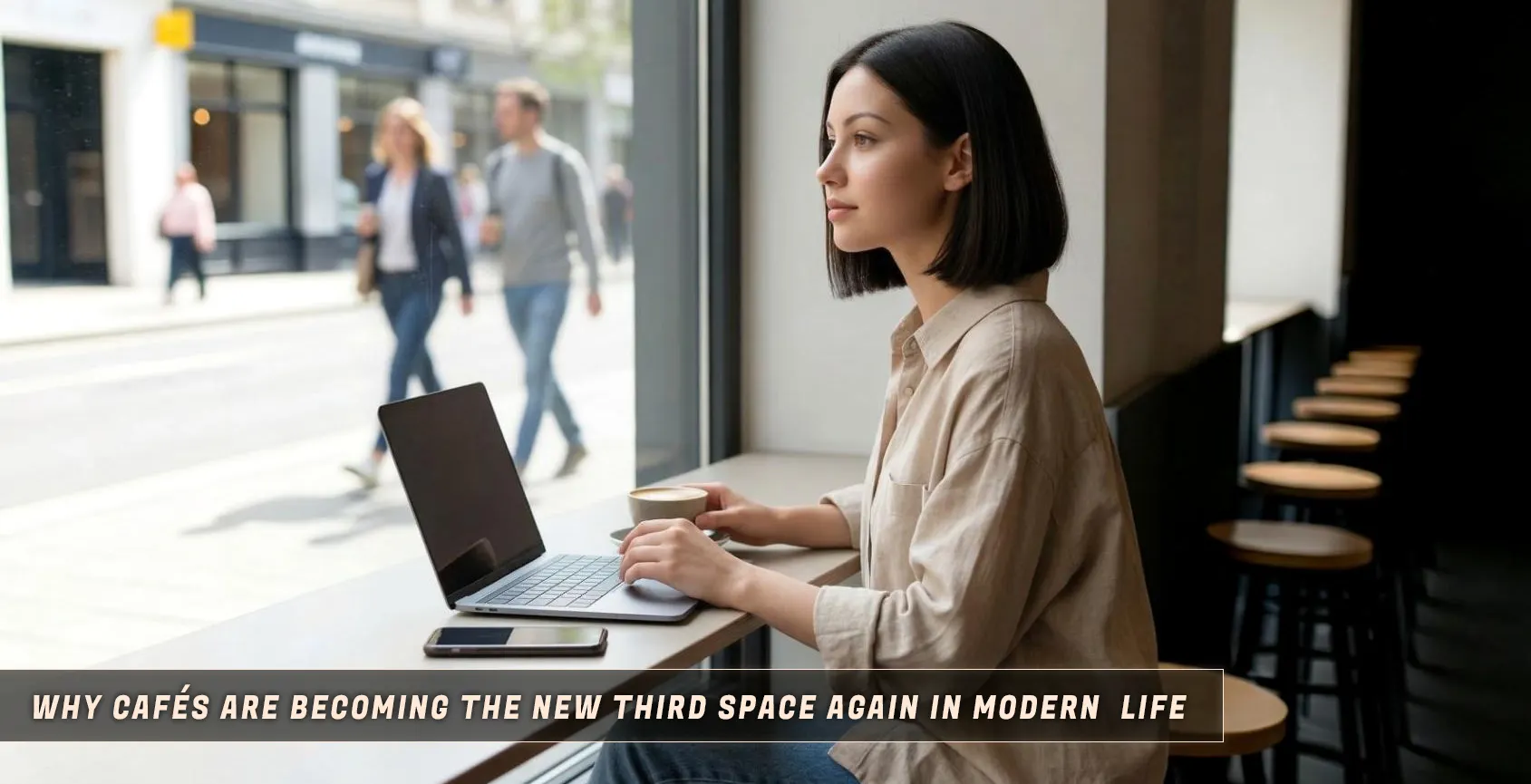
Not quite home. Not quite work.
But somewhere in between — where people can sit, stay, and simply exist for a while.
That space is quietly returning.
For a long time, daily life revolved around two places.
Home — where you lived.
Work — where you showed up.
Everything else felt temporary. In-between. Optional.
But over time, something started to go missing.
A space that wasn’t tied to responsibility.
A space that didn’t demand productivity.
A space where you could just be present without needing a reason.
And slowly, cafés began filling that gap again.
What Is a “Third Space”?
The idea of a “third space” is simple.
It’s a place that exists outside of home and work — where people can gather, spend time, and feel a sense of belonging without pressure.
Traditionally, these spaces looked like:
- Parks and public squares
- Libraries
- Community centers
- Local hangout spots
Places where time wasn’t tightly structured.
Places where presence mattered more than purpose.
Why It Disappeared for a While
Over the years, many of these spaces became less central to everyday life.
Cities grew faster. Work became more demanding. Digital platforms replaced physical interaction.
People started spending more time:
- At home, often alone
- At work, often busy
- Online, often distracted
The space in between began to shrink.
Even socializing became scheduled rather than spontaneous.
Why Cafés Are Filling That Role Again
Cafés offer something that modern life often lacks: low-pressure presence.
You don’t need a reason to be there.
You can work — or not work.
You can talk — or sit quietly.
You can stay for an hour — or longer.
That flexibility makes cafés feel different from most other spaces.
A café doesn’t demand attention.
It allows it.
A Space That Feels Both Social and Private
One of the unique things about cafés is their balance.
They are social spaces — but not overwhelming ones.
You’re surrounded by people, but not required to interact.
That creates a subtle sense of comfort:
- You’re not alone
- But you’re also not on display
- You can observe without participating
For many, that’s exactly the kind of environment that feels right today.
Work, But Not Work
Remote work has also changed how people use cafés.
Instead of offices, many now choose environments that feel lighter and less structured.
A café offers:
- Background energy without pressure
- A change of environment from home
- A sense of routine without rigidity
It’s not about productivity alone.
It’s about how a place feels while you’re working.
The Return of Unstructured Time
What cafés really bring back is something subtle: unstructured presence.
Time that isn’t tightly scheduled.
Moments that don’t need to be optimized.
A setting where you can pause without explaining why.
In a world that often pushes constant activity, that kind of space becomes valuable.
Not because it’s rare.
But because it’s increasingly intentional.

Why This Shift Matters
The return of cafés as third spaces reflects a larger cultural shift.
People are starting to look for environments that feel:
- Slower
- More human
- Less demanding
Not everything needs to be efficient.
Not every moment needs to be productive.
Sometimes, what people are really looking for is a place where they can sit — and not feel rushed to leave.
🔗 Follow & Read More:
Medium: https://medium.com/@casiborg
X (Twitter): https://x.com/casiborg
📬 Stay updated: https://linktr.ee/casi.borg
📰 Subscribe to our newsletter for weekly crypto insights, AI analysis, and market intelligence
❓ Do you go to cafés to work, to relax — or just to feel like you’re somewhere in between?
No responses yet